

How AI Energy Demand Is Reshaping Corporate Climate Strategy
Sustainability & ESG / September 17, 2026
By Mary Riddle, Vice President, Sustainability Strategy
The rapid growth of generative AI is accelerating data-center electricity demand and infrastructure investment. What does that mean for companies pursuing net-zero goals and other ambitious climate commitments?
Why AI Is Disrupting Corporate Decarbonization Plans
Until recently, many corporate decarbonization roadmaps were built around relatively predictable trajectories toward net-zero targets by a set date. Artificial intelligence is complicating those trajectories.
Major technology providers and companies expanding their use of AI are confronting the energy, infrastructure and physical-resource demands associated with training models, running AI applications and building the data centers required to support them.
Microsoft offers a clear example. In fiscal year 2025, the company reported a 25% year-over-year increase in its total Scope 1, 2 and 3 greenhouse gas emissions. Microsoft attributed the increase primarily to the expansion of its data-center infrastructure and its decision to pause the use of non-additional, unbundled Renewable Energy Certificates (RECs) as it prioritizes investments that bring new carbon-free electricity to the grid.
The composition of Microsoft’s footprint also shifted. Scope 2 emissions represented 13% of its total emissions in FY2025, up from nearly 2% the previous year.
Google faced similar pressures, but its results illustrate why the AI emissions story is more complicated than simply rising energy use. Google’s electricity demand increased 37% in 2025 as AI infrastructure expanded, yet the company reduced its operational emissions by 2%. At the same time, its supply-chain emissions increased 25%, reflecting the infrastructure, equipment and manufacturing required to support continued growth.
The International Energy Agency (IEA) estimates that data centers consumed about 485 terawatt-hours (TWh) of electricity globally in 2025. By 2030, that figure is projected to reach approximately 950 TWh — roughly double today’s level and slightly more than Japan’s current annual electricity consumption.
For companies with ambitious climate targets, the challenge is becoming clear: AI can create business value while also adding new energy demand, infrastructure requirements and emissions that may not have been fully anticipated when corporate climate strategies were established.
Where AI’s Carbon and Resource Footprint Comes From
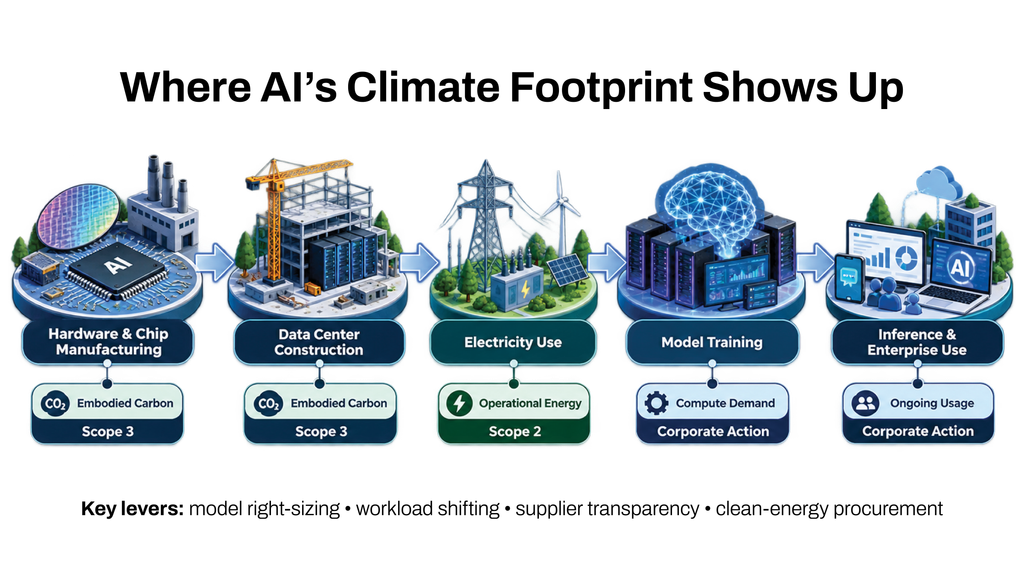
Understanding how AI affects corporate carbon budgets requires looking beyond the electricity required to train a model.
Inference vs. Training
Large-scale model training attracts much of the attention because individual training runs can consume enormous amounts of computing power. But training represents only one part of an AI model’s lifecycle.
Inference — the process of running a trained model to answer queries and perform tasks — occurs continuously once an application is deployed. A 2026 review published in Nature Reviews Clean Technology estimates that aggregate inference can contribute 40% to 60% of an AI model’s lifetime carbon dioxide-equivalent emissions.
For companies deploying AI at scale, that distinction matters. The environmental impact is not limited to building or training a model. It continues every time employees, customers or automated systems use it.
Embodied Carbon and Scope 3 Emissions
Advanced graphics processing units (GPUs), high-density server racks, cooling equipment, networking infrastructure and data-center construction all require energy- and material-intensive manufacturing.
AI also has a substantial physical footprint.
Research published in Nature Reviews Clean Technology estimates that embodied emissions from activities such as chip fabrication and data-center construction can account for more than half of the emissions associated with large AI data centers.
For many corporate AI users, these emissions may appear primarily within Scope 3 rather than their own operational footprint. That makes supplier transparency and value-chain emissions increasingly important as AI adoption grows.
For more on the challenge of identifying and managing indirect emissions, see OBATA’s Navigating Scope 3 Emissions: Challenges and Solutions.
Grid Constraints and Water Use
AI data centers also create unusually concentrated demand for electricity. Unlike many commercial operations, large computing facilities may require dense, continuous power loads around the clock.
The environmental consequences depend heavily on where that electricity comes from. Facilities operating on grids with higher-carbon generation can create different emissions impacts than those supported by grids with greater access to low- or zero-carbon electricity.
Water adds another layer of complexity. Data centers can require significant water for cooling, although consumption varies widely depending on cooling technology, climate, facility design and operating conditions. Reducing water consumption can also involve energy tradeoffs, which means companies need to evaluate carbon, water and energy impacts together rather than in isolation.
Why AI Is Raising the Bar for Clean-Energy Claims
The growth of AI is also increasing scrutiny of how companies substantiate renewable-energy and emissions claims.
Renewable Energy Certificates and carbon offsets are sometimes discussed together, but they serve different purposes. A REC represents the renewable attributes associated with one megawatt-hour of renewable electricity generation. Carbon credits or offsets represent quantified reductions or removals of greenhouse gas emissions.
RECs remain an established mechanism for substantiating renewable-electricity claims and calculating market-based Scope 2 emissions. But rapidly increasing electricity demand is putting greater emphasis on another question: Does a company’s clean-energy strategy help expand the supply of carbon-free electricity where and when that electricity is needed?
That distinction helps explain Microsoft’s decision to pause its use of non-additional, unbundled RECs while prioritizing investments in new carbon-free electricity generation.
The larger shift is not that RECs have suddenly become obsolete. Instead, companies are facing greater pressure to understand the timing, location and additionality of their clean-energy procurement — and to communicate those choices accurately.
As AI increases electricity demand, the credibility of corporate climate claims will depend increasingly on explaining not only what a company purchases or reports, but what those actions actually accomplish.
Decarbonization Strategies for Enterprise AI Use
Companies deploying AI do not control every aspect of the infrastructure supporting it. But they can take steps to reduce unnecessary energy use and better understand the emissions associated with their technology choices.
Right-Size Models and Reduce Unnecessary Inference
Not every business task requires the largest and most computationally intensive AI model available.
Companies can match model size and capability to the complexity of the task, use smaller or specialized models where appropriate, and avoid repeating identical calculations when responses can be safely cached and reused.
The principle is straightforward: use the computing power the task requires rather than defaulting automatically to the most resource-intensive option.
Shift Flexible Workloads to Lower-Carbon Times and Regions
Not every computing workload has to run immediately or in a fixed location.
Non-urgent activities such as batch processing, data-pipeline workloads and some model fine-tuning can potentially be scheduled for periods or regions with greater availability of lower-carbon electricity.
Research suggests that grid-integrated workload management could reduce AI lifecycle carbon emissions by approximately 10% on grids with high renewable-energy penetration.
Strengthen Clean-Energy Procurement and Supplier Expectations
For organizations purchasing cloud and AI services, decarbonization increasingly involves understanding what technology providers are doing behind the interface.
Companies can ask providers how electricity is sourced, how emissions are calculated, what progress is being made toward lower-carbon infrastructure, and what data is available to enterprise customers for their own greenhouse gas inventories.
Larger buyers may also consider how Power Purchase Agreements, carbon-free electricity procurement and other mechanisms can support cleaner electricity generation.
Address Residual Emissions With High-Integrity Carbon Removal
Even aggressive emissions-reduction strategies may leave residual emissions that cannot currently be eliminated.
High-quality carbon removal can play a role in addressing those residual emissions, particularly when reductions have been prioritized first. Approaches include nature-based removals as well as engineered pathways such as Direct Air Capture with geological storage and mineralization.
The quality, permanence, additionality and verification of these projects matter.
For a deeper discussion, see OBATA’s The Role of Carbon Credits in Corporate Decarbonization Plans.
How AI Can Also Support Decarbonization
AI infrastructure creates an environmental challenge, but the technology can also help organizations and industries reduce energy use and emissions when applied intentionally.
The IEA estimates that widespread adoption of existing AI applications across end-use sectors could contribute as much as 1,400 million metric tons of CO2 emissions reductions in 2035.
That is a scenario, not a forecast. The IEA cautions that significant barriers — including limited access to data, digital infrastructure, skills and supportive regulatory conditions — could prevent those reductions from being fully realized.
Potential applications include:
Grid Balancing
Machine-learning models can improve forecasts for electricity demand and variable renewable generation, helping grid operators integrate solar and wind more effectively.
Industrial Efficiency
AI-enabled controls can optimize manufacturing processes, equipment performance, fuel use and energy consumption. In energy-intensive industries, even relatively small efficiency gains can translate into meaningful emissions reductions.
Methane Detection
Satellite analytics, sensors and computer vision can help identify methane leaks from oil and gas infrastructure more quickly, allowing operators to locate and repair emissions sources sooner.
Building Energy Management
AI-enabled building-management systems can adjust heating, ventilation, air conditioning and other building systems based on occupancy, weather and operating conditions. The IEA estimates that optimized HVAC controls can reduce building energy consumption by approximately 10% in applicable systems.
What Corporate Sustainability Teams Should Do Now
The important question is not whether AI is inherently good or bad for corporate climate performance. Its impact depends on how the technology is deployed, what infrastructure supports it and whether organizations understand the resulting energy and emissions consequences.
For sustainability teams, that creates several practical questions:
- Where does AI-related energy use appear in our Scope 1, Scope 2 and Scope 3 inventory?
- How much visibility do we have into the energy and emissions performance of our cloud and AI providers?
- Are AI infrastructure requirements changing assumptions behind existing climate targets?
- Do our renewable-energy and carbon-removal claims accurately reflect the mechanisms we are using?
- Are we evaluating AI’s potential environmental benefits alongside the footprint required to deliver them?
Corporate climate strategies increasingly need to account for a technology environment that can change faster than long-range targets.
That does not necessarily mean abandoning net-zero commitments. It means continually testing the assumptions behind them, improving visibility into energy and value-chain impacts, and making sure sustainability disclosures keep pace with how the business is actually changing.
For organizations reassessing how AI affects climate priorities, disclosure and stakeholder expectations, OBATA’s Sustainability Consulting & Advisory Services can help connect strategy, reporting and communication.
Is Your Climate Strategy Keeping Pace With AI?
AI is changing the assumptions behind corporate energy use, Scope 3 exposure and net-zero commitments. OBATA helps sustainability teams reassess priorities, strengthen strategy and disclosure, and communicate evolving climate performance with greater clarity and credibility.
Book a Strategic Sustainability Consultation
About the author
Mary Riddle is a sustainability strategy specialist with more than a decade of experience helping public and private companies develop ESG strategies, set goals, and communicate performance. She holds a Master of Science in Sustainability Solutions and is a GRI Certified Sustainability Professional.