

Integrated Reporting: Bridging Finance and ESG for Corporate Value
Sustainability & ESG, Guides / October 26, 2025
By Mary Riddle, Vice President, Sustainability Strategy
The convergence of financial and sustainability disclosures challenges corporate teams to move beyond parallel reports and build one connected, decision-useful narrative. This demands a strategic shift in governance, data, and storytelling that is more than simply combining two documents.
Integrated reporting enables organizations to create a single, coherent narrative that connects financial performance, value creation, risks, and sustainability impacts.
Investors, regulators, and rating agencies now demand one unified story that links economic performance, strategy, governance, and future prospects. To navigate this complexity and ensure long-term value, you need a proven, structured approach.
This guide outlines the key elements of an integrated reporting approach, drawing on OBATA’s longstanding experience in corporate reporting.
The Growing Demand for Integrated Reporting
Integrated reports emphasize the vital link between financial health and sustainability performance. A single, coherent narrative is now required to connect a company’s performance, value creation, risks, and sustainability impacts for all stakeholders.
Insight to Consider
Why are global standards converging toward integrated reporting?
Because investors and regulators increasingly expect unified, comparable disclosure that connects financial and sustainability performance under shared frameworks such as ISSB and CSRD.
The drive toward integrated corporate reporting is powered by consolidating global standards. The Value Reporting Foundation (VRF), formed by the merger of the IIRC and SASB, later consolidated into the International Financial Reporting Standards (IFRS) Foundation.
In November 2021, IFRS created the International Sustainability Standards Board (ISSB), which released its inaugural disclosure standards, IFRS S1 and IFRS S2, in June 2023.
These standards build directly on the framework of the Task Force on Climate-related Financial Disclosures (TCFD). The European Union’s Corporate Sustainability Reporting Directive (CSRD), adopted in 2022, mandated the use of European Sustainability Reporting Standards (ESRS), finalized in July 2023.
ISSB standards are poised to become the global baseline, while the EU pursues its more expansive, double-materiality-driven CSRD/ESRS framework.
Both the ISSB and the EU’s CSRD explicitly guide companies toward integrated reporting, bridging financial and sustainability disclosures with the same rigor, assurance, and digital tagging.
What Integrated Reporting Looks Like in Practice
For Reporting Leaders
How does integrated reporting change the role of the annual report?
It transforms the annual report into the single, authoritative source of corporate truth, integrating financial and ESG data into one coherent narrative.
An integrated report is a single document with one narrative and one dataset that produces multiple outputs. The annual report (or management report) becomes the “home” for all narratives and data. Investor decks, websites, microsites, and regulatory filings all reference the annual report as their single source of truth.
The report highlights how a company manages multiple kinds of capital, financial, human, social, intellectual, natural, and more, and integrates decision-useful metrics into the overall reporting framework.
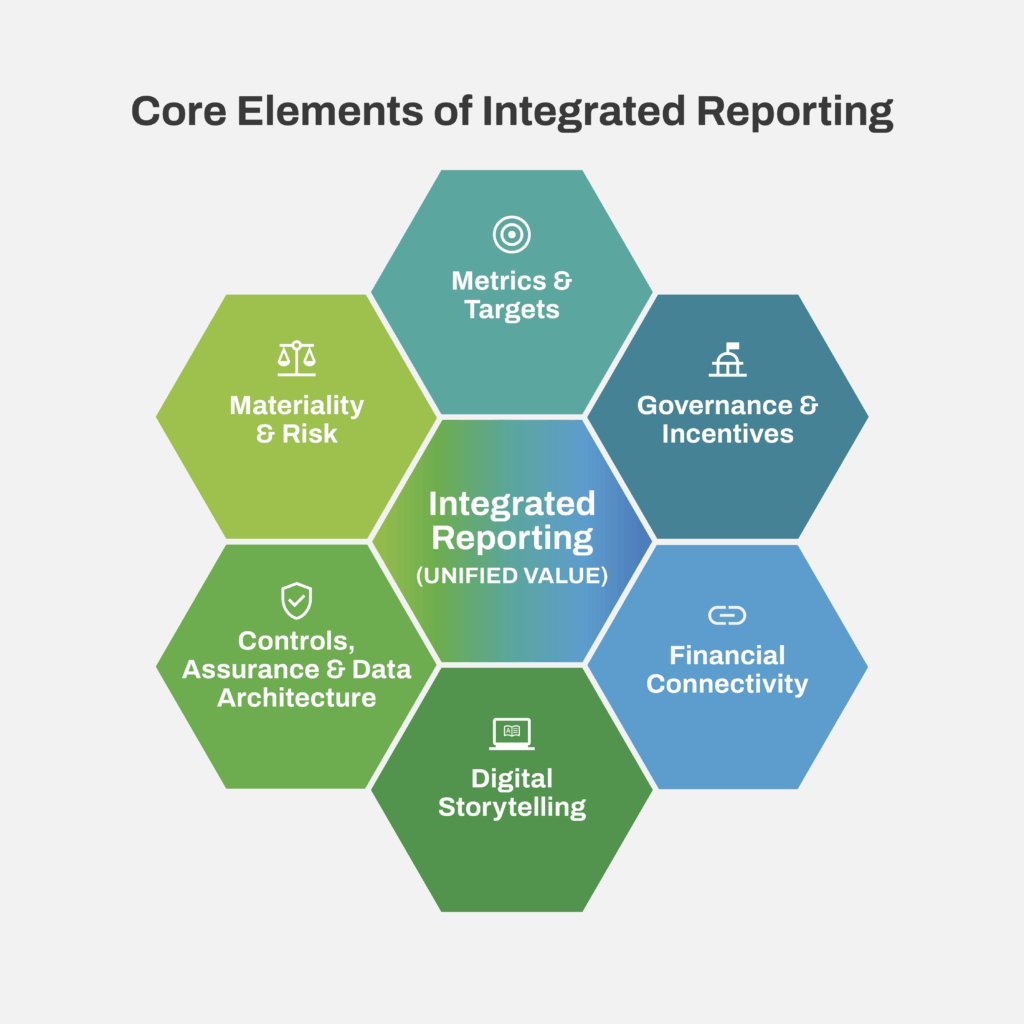
Core Elements of Integrated Reporting
Why It Matters
What are the key elements of integrated reporting?
Materiality, metrics, governance, assurance, and connectivity between financial and sustainability data — brought together in one cohesive report.
To achieve a truly integrated report, your team should focus on the following core elements:
Materiality and Risk:
Use double materiality where required and appropriate. Reports aligned with ISSB must also show how financial materiality assessment outcomes link to enterprise value and stress-tested scenarios. Reports should clearly connect principal risks and opportunities to metrics, budgets, and controls using quantitative data.
Metrics and Targets:
Metrics should be harmonized across financial and sustainability sections and cross-referenced where needed. Metrics should show baselines, interim milestones, and any sensitivity (e.g., carbon price or interest rates).
Governance and Incentives:
Disclose the level of board oversight across sustainability and financial disclosures. Executive remuneration should be linked to a balanced KPI set.
Financial Statement Connectivity:
Key sustainability topics should be clearly linked to profit & loss, cash flow, and balance sheet impacts (e.g., capex for decarbonization, opex shifts). Identify where climate and nature risks appear in scenario analysis and enterprise risk management.
Controls, Assurance, and Data Architecture:
Apply financial-grade internal controls to sustainability data and prepare early for limited and reasonable assurance. Maintain a register of controls, owners, and evidence. Invest in robust data platforms.
Digital First:
Use iXBRL/ESEF tagging where required; provide downloadable data tables and APIs where possible.
Plain-English Storytelling:
Keep the report concise and push deep technical detail to appendices. Use consistent definitions and cross-references.
OBATA guides your team through the technical alignment of these elements to ensure compliance and create a report that truly drives value.
A Proven Integrated Reporting Roadmap
Based on our longstanding experience in corporate reporting, OBATA developed an established methodology to help your team navigate the transition to integrated reporting with confidence.
Phase 1: Establish Governance and Strategy
Establish governance with a joint Finance-Sustainability steering group. Engage early with external assurance providers to plan for necessary controls. Complete a gap analysis to uncover hurdles to implementation and select voluntary frameworks aligned with investor priorities.
If your organization hasn’t recently completed a materiality assessment, do it at this point.
Phase 2: Build Controls and Data Architecture
Map out data owners, controls, and systems. Within the steering group, agree on harmonized definitions and a calendar that locks down material sustainability data in line with the financial year close.
Phase 3: Draft and Connect the Narrative
The steering committee, along with external consultants, collaborates to outline key sections of the integrated report: strategy, risk, metrics, qualitative narratives, and financial data. Prepare for digital tagging early.
Consult with the audit provider to analyze pre-assurance readiness.
Phase 4: Assure and Finalize the Report
Seek assurance on sustainability information, either limited or reasonable. Conduct a legal review and board sign-off. Publish a unified report with data tables and microsites as needed.
Phase 5: Learn and Adapt for the Future
Capture stakeholder feedback and analyze readiness for evolving standards (ISSB adoption, CSRD timeline, ESRS sector guidance).
Common Pitfalls to Avoid
Integrated reporting presents several common traps that can undermine credibility and impact:
Poor Digital Hygiene:
Work with a design and web team early to prioritize tagging, downloadable tables, and clean cross-links.
Telling Two Different Stories with Two Different Datasets:
A co-led Finance-Sustainability steering committee is critical. If finance says one thing and sustainability another, fix it with a single KPI catalog, cross-functional sign-off, and ongoing dialogue.
Treating Assurance as an Afterthought:
Do not postpone building out controls; plan for assurance readiness early.
Over-Reliance on Boilerplate Language:
Avoid vague, ready-made transition plans or risk narratives. Quantify pathways and capital expenditures in advance.
The Long-Term Value of Integrated Reporting
The process of creating an integrated report is complex, but its value proves long-lasting. As standards consolidate and regulations mature, this work builds the governance, controls, and data architecture necessary for long-term resilience and sustained value.
The front-loaded effort pays off in a unified, credible, and decision-useful report that meets the demands of a modern market.
Drawing on our experience guiding companies through these transitions, OBATA partners with organizations to align finance and sustainability teams, streamline data architecture, and craft a single narrative that resonates with investors.
Ready to build a unified, credible report that connects finance, strategy, and sustainability?
Explore how OBATA’s ESG & Sustainability Reporting Services can help you align disclosures, streamline governance, and elevate your narrative.