

Which Sustainability Data Platform is Best For You?
Sustainability & ESG, Guides / October 6, 2025
By Mary Riddle, Vice President, Sustainability Strategy
If you’re still using an Excel spreadsheet to track your sustainability data, you’re probably due for an upgrade.
Choosing a sustainability data platform for collecting and managing sustainability data is a daunting task. With ever-changing regulations and specific requirements from supply chain partners, it can be difficult to figure out which platform will meet your needs.
A quick Google search often yields a long list of sponsored ads, making it even harder to find a system with real value.
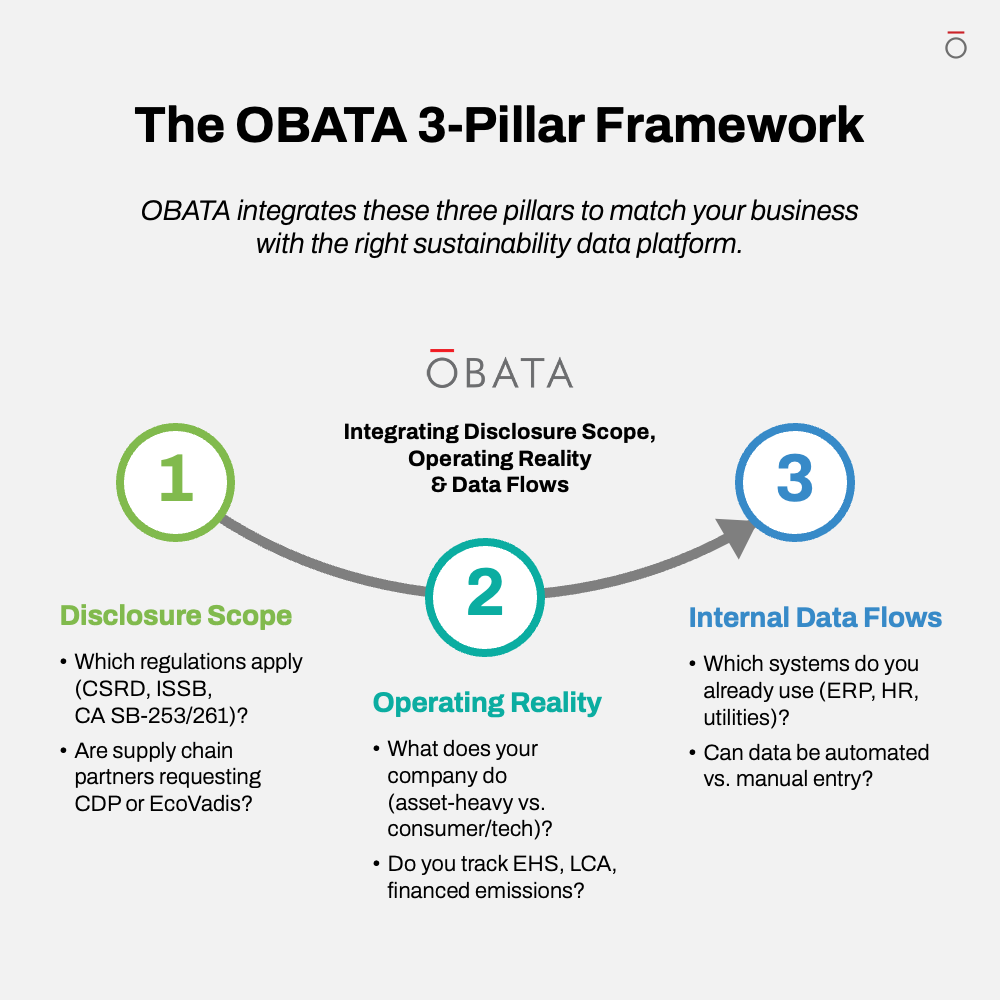
To choose the right platform, you need to understand three key things about your business:
1. Your disclosure scope.
- Which regulations are you currently in scope for, and which are coming soon?
- Are you tracking CSRD, ISSB, or California SB-253/261?
- Are your supply chain partners requesting EcoVadis or CDP submissions?
2. Your operating reality.
- What does your company do?
- What kinds of facilities, utilities, suppliers, financed emissions, product LCA, EHS processes do you have to consider?
3. Your internal data flows.
- Does your company already use specific information systems and utility bill feeds?
Understanding these three things will help you narrow down your options and find the best system for your company.
Platform Snapshots
Note: We are not a paid partner for any data platform or software, and we do not receive any financial incentives for providing these recommendations.
Watershed
Watershed is an enterprise climate platform designed to help companies measure and reduce emissions. It features strong supplier-engagement tools for Scope 3 reporting and includes a built-in marketplace for clean power procurement and carbon removal. The platform is highly action-oriented, offering suppliers clear, user-friendly workflows. However, because it is primarily carbon-focused, companies will still need to pair it with HR or other systems to capture broader social and governance metrics.
Benchmark Gensuite
Benchmark Gensuite is a well-established EHS platform with sustainability and disclosure modules (including CSRD) built in. It is a strong fit for asset-heavy industries that already manage environmental permitting or safety workflows and want ESG integrated into the same system. Trusted in the EHS space for its broad industry coverage, particularly in chemicals, energy, manufacturing, and oil & gas, the platform is also ISSB-aligned. However, it still feels primarily like an EHS system, and implementation can come with a steep learning curve.
Tracera
Tracera is a newer traceability platform designed for finance and sustainability teams seeking auditability. It emphasizes automated data extraction and verification, providing a single hub for emissions and sustainability data across more than 900 metrics. The interface is sleek and modern, though its integration ecosystem is smaller than that of more established platforms.
Novisto
Novisto is a “system of record” for ESG data management, with expanding CSRD coverage. It is used across industries and continues to scale in the EU. The platform includes a supplier portal for Scope 3 and an end-to-end data model for multi-framework reporting, though it is less carbon-specialized than Persefoni or Watershed.
Position Green
Position Green is a data collection suite with ready-to-go CSRD solutions, carbon accounting tools, and supply-chain modules. It has a strong EU focus, but that can be tricky for customers outside of Europe.
IBM Envizi
IBM Envizi is an assurance-grade, data-centric sustainability suite within IBM. It offers a rare public pricing signal via AWS Marketplace (where Envizi Essentials is listed at $30,000 per year) and an IBM price estimator. It offers a single “system of record” design, but costs scale with data volume/modules.
Persefoni
Persefoni is a carbon accounting and disclosure platform with both a free Pro tier and an enterprise-level Advanced plan. It emphasizes assurance-grade calculations and regulatory packs (SEC, CSRD, ISSB), along with PCAF coverage for financed emissions. The platform provides a credible audit trail and specialized models for financial services. Its free starter tier is particularly useful for companies beginning their carbon reporting, allowing them to build baseline data and test integrations before committing to an enterprise contract. However, Persefoni is carbon-focused, so companies tracking broader social and governance metrics will need to supplement it with additional tools.
VisiumKMS
VisiumKMS is an EHS platform used in regulated sectors (oil & gas, chemicals, energy, manufacturing). However, it does include ESG metrics.
ESG Book
ESG Book is a data management platform with framework mapping that also includes data products (for example, estimated emissions for about 45k public companies as of time of publishing). The platform is aligned to CSRD and ISSB.
Rules of Thumb for Sector Fit
- Highly regulated industries such as energy, chemicals, and manufacturing often favor EHS software like Benchmark Gensuite, VisiumKMS, or Envizi, which offer native workflows for air, water, waste, permits, and EHS.
- Tech, retail, consumer, and other companies with large Scope 3 footprints are well-suited to Watershed, with its top-tier supplier portal and marketplace, or to Persefoni for its robust Scope 3 capabilities.
- EU-based companies often choose Position Green or Novisto for CSRD readiness, or ESG Book for framework mapping and data exchange.
- Financial services firms with financed emissions frequently prefer Persefoni for its portfolio analytics.
What Does it Cost?
Pinpointing exact pricing is challenging, as most platforms operate on a quote-based model, but a few benchmarks exist.
Persefoni offers a free Pro tier for a single user, while IBM lists Envizi Essentials at $30,000 per year on AWS.
Key cost drivers include the number and type of modules (carbon, water, waste, supplier portals, EHS, CSRD packs), data volume (locations, transactions, etc.), users and entities (subsidiaries, portfolio companies), integrations with other systems, and the level of support, which can range from self-serve to concierge with assurance-grade documentation.
You can cross-reference any quotes with IBM’s public price estimator.
Bottom Line
There is no single “best” platform, but there is a best fit for your data flows, regulatory scope, and operating model. Prioritize auditability and supplier coverage, and check costs using available benchmarks (such as Envizi’s AWS listing or Persefoni’s free tier) before adding modules. Most importantly, choose the tool your team will actually use, not just the one that looks impressive in a demo.
Need help determining which data platform is right for your company?
Let OBATA assist you in the selection, and setup, of your data collection platform.