

Four Smart Ways to Share Your Sustainability Report
Sustainability & ESG, Guides / June 24, 2026
By Paul Gassett, Chief Executive Officer
This article was originally published in 2022 and has been substantially updated to reflect today’s sustainability reporting environment.
Producing a sustainability report is only half the work. How you distribute it determines who reads it, who trusts it, and whether it builds the credibility you need with investors, regulators, employees, and customers. This guide covers four proven distribution strategies, plus two questions every company should answer before choosing them.
First: What Are You Calling It?
Before deciding how to share your report, companies today face a strategic question that did not exist a decade ago: what do you call it?
The answer matters more than it once did. Each term signals something different — about your audience, your emphasis, and the kind of story you are telling. Understanding the distinctions helps you choose deliberately rather than by default.
Some of the most common options for naming these types of reports include:
An ESG Report communicates investor-grade disclosure across environmental, social, and governance pillars, aligned to recognized frameworks such as GRI, SASB, or ISSB. It signals rigor, comparability, and a primary audience of investors and ratings agencies. In the U.S., the term has become politically charged. The share of S&P 100 companies using “ESG” in their report titles dropped from 40% in 2023 to 25% in 2024, and by early 2025 only 6% had used it. Many companies have moved away from the label in public communications while continuing the underlying work.
A Sustainability Report is now the most common choice among large U.S. public companies, appearing in 39% of S&P 500 report titles in 2024. It emphasizes environmental performance, resource management, operational resilience, and long-term business strategy. It is broad enough to accommodate both investor-facing data and stakeholder-facing narrative without carrying the political associations of ESG.
CSR Report — Corporate Social Responsibility — remains a deliberate and legitimate choice, particularly for mid-size companies, private companies, professional services firms, and organizations where the social story is primary. CSR tends to emphasize community impact, employee programs, philanthropy, and social responsibility more than investor-grade framework alignment. It is a different signal than Sustainability or ESG, not an older synonym. Companies that choose it are often communicating to employees, customers, and communities rather than to institutional investors and ratings agencies. Several OBATA clients, including MasterBrand and Stephen Gould, have chosen this label intentionally, and it continues to appear regularly across the market.
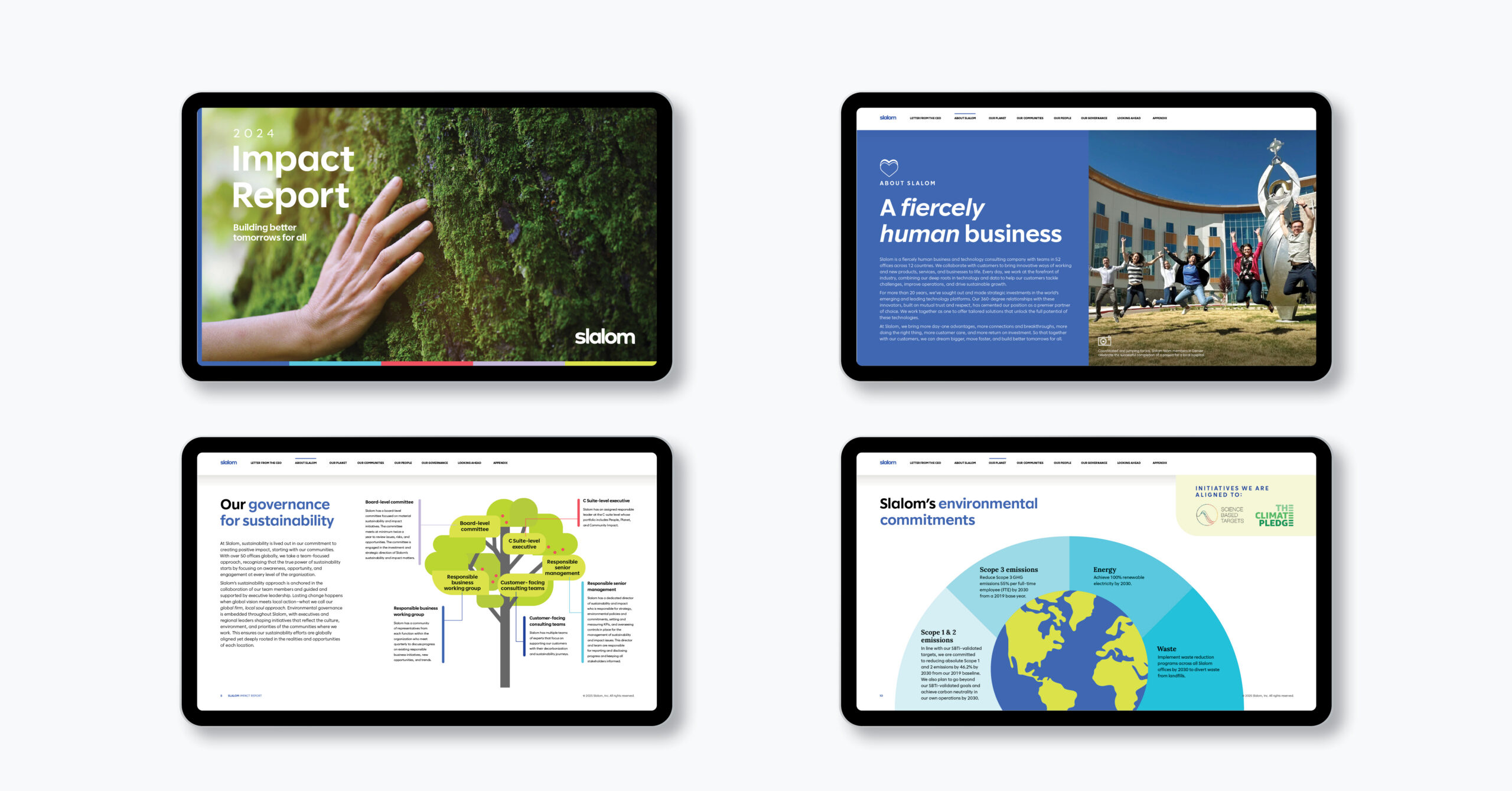
An Impact Report is growing fastest, particularly in consulting, professional services, and purpose-driven organizations. It focuses on measurable outcomes for people and communities, tends to be less framework-intensive than an ESG report, and often carries a more narrative voice. Slalom’s 2024 Impact Report is one example. The term sidesteps the political debate around ESG entirely while still communicating genuine commitment to accountability.
The terminology shift since 2023 is real and well-documented
We have seen it directly in our own work. Clients who once led with “ESG Report” on their covers are increasingly choosing “Sustainability Report,” “Impact Report,” or “CSR Report” depending on their audience and emphasis. While the label may change, the commitment behind it generally does not.
What matters for distribution is this: the four strategies that follow apply equally regardless of what you call the document. The name is a communications decision. The distribution formats are neutral.
One additional consideration: the terminology shift away from ESG is primarily a U.S. phenomenon. European companies reporting under the EU’s Corporate Sustainability Reporting Directive (CSRD) continue to use the full ESG framework. For multinationals operating in both environments, managing consistent messaging across that divide requires deliberate planning.
The Smart Reporting Ecosystem: the “What” and the “How”
The annual sustainability report is a disclosure document, but it is also an opportunity to tell stories of your company’s progress as well as the local impacts your employees are having in the communities where they live and work. Stakeholders care about the data, the “what,” but also about the “how,” or how your sustainability initiatives are having a real impact on your people and the public perception of your company.
Based on this, as the need for credible, accessible sustainability communication grows, there is increasing value in reaching diverse stakeholders in multiple ways. Sharing your sustainability message across multiple formats strengthens its overall impact, much as integrated marketing communications does for brand and product messaging.
Companies are also moving toward more continuous communication throughout the year. This means year-round conversation rather than a once-a-year event.
Four ways to deliver your report:
- The Interactive PDF
- Sustainability Websites, Microsites, and Hubs
- Report Highlights and Data Summaries
- Stakeholder Amplification
Touchpoint #1:
The Interactive PDF Sustainability Report
An interactive PDF is a digital version of your sustainability report designed for screens, not just print. It includes a clickable table of contents, internal navigation links, hyperlinks to external frameworks and source data, and in some cases, embedded video. It is delivered as a downloadable file, easy to share by email, post on a website, or distribute across social media.
For the vast majority of companies, the interactive PDF is the primary and often sole distribution format. When designed with care, it is entirely sufficient.
As reports have grown longer and more complex, navigation has become critical. Readers should be able to move between sections in two clicks or fewer. Accessibility standards, including screen reader compatibility and sufficient color contrast, should be built in from the start.
One consideration that has grown more important in recent years is the need for claims in the PDF to align with what appears on your website, in investor filings, and in any other external communications. Inconsistency across formats is now a compliance and reputational risk, not just a communications oversight.
Benefits of the Sustainability Interactive PDF:
- Delivers clear navigation that helps readers find information quickly
- Supports links to data appendices, framework indexes, and external sources
- Can be structured to serve multiple audiences, investors, employees, customers, and regulators, in a single, easily-navigable document
- Easy to distribute via email, investor relations pages, and social media
Touchpoint #2:
Sustainability Websites & Microsites
Web-based options extend the reach of your sustainability story by improving accessibility, enabling discovery through search engines, and keeping content current between annual reporting cycles. There are two distinct expressions of this approach.
The Report Microsite
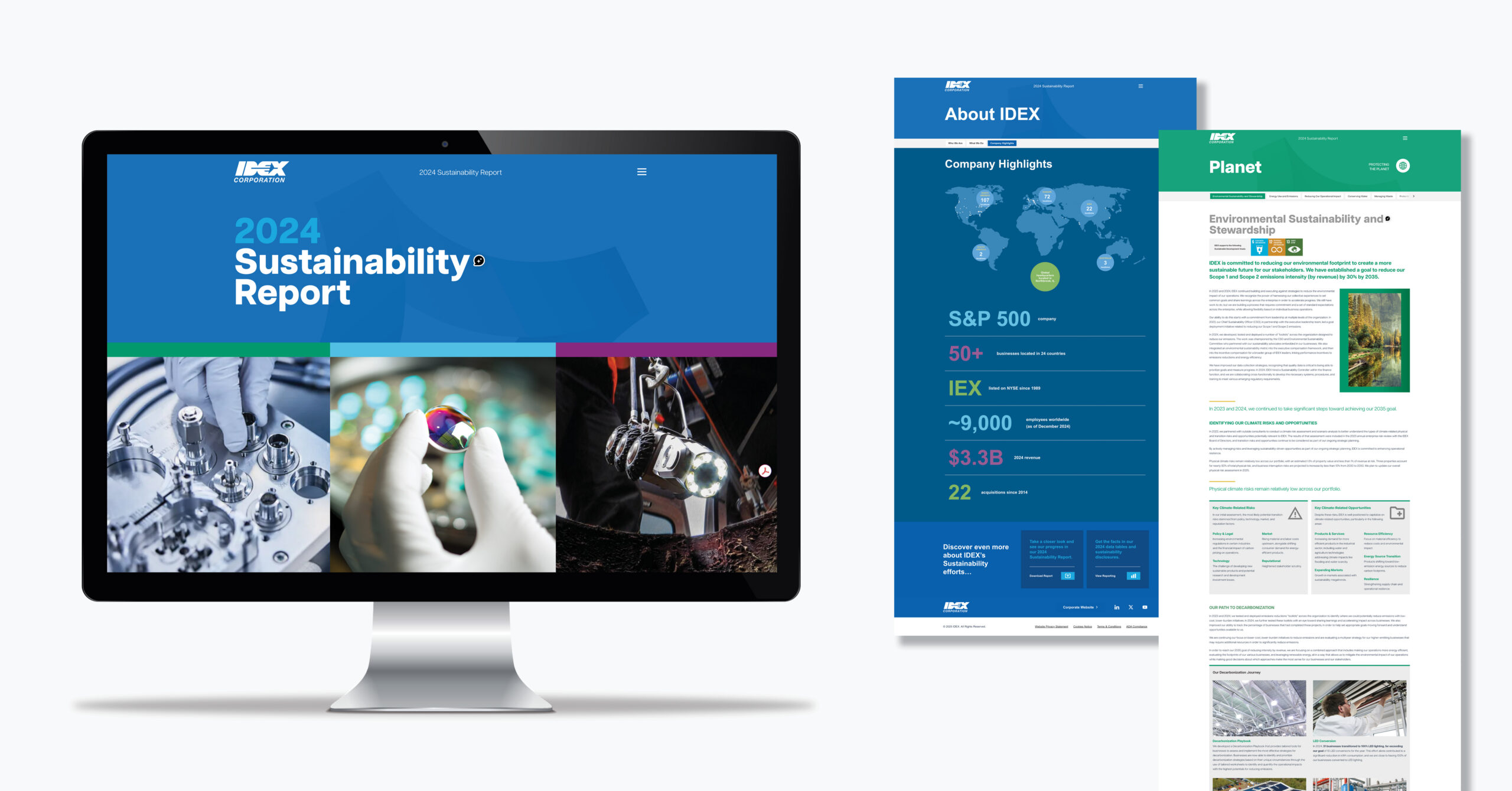
A report microsite is a standalone website, typically on its own subdomain, that presents the full annual report as an interactive digital experience. It mirrors the content of the PDF in a responsive, mobile-friendly format that is more accessible to ratings agencies, investors, and stakeholders who prefer web-based content.
Microsites can also be indexed by search engines, which makes the report discoverable through organic search rather than only through direct links. They can incorporate analytics, allowing your team to see which sections draw the most engagement. That data can directly inform how you structure future reports.
Chevron Phillips Chemical, IDEX Corporation, and Mercer International are examples of companies that have paired their annual PDF with a full report microsite to extend its reach and impact. It is critical to leverage the look and feel developed for the interactive PDF document.
Benefits:
- Improves accessibility for ratings agencies, investors, and all stakeholder audiences
- Enables search engine optimization, so stakeholders can find your sustainability content organically
- Supports analytics that inform future report structure and content priorities
- Allows content to be updated throughout the year, not only at report release
- Creates a permanent home for policies, framework indexes, past reports, and ongoing stories
Touchpoint #3:
Report Highlights and Data Summaries
Sustainability reports continue to grow in length and complexity as companies report across more frameworks, more metrics, and more geographies. While comprehensive disclosure is increasingly expected, it is unrealistic to expect all stakeholders to engage with a 60- to 100-page document in its entirety.
Concise summary formats give specific audiences the key takeaways they need without requiring them to read the full report. Think of them as the financial highlights page of an annual report, applied to sustainability.
Downloadable Data Summary
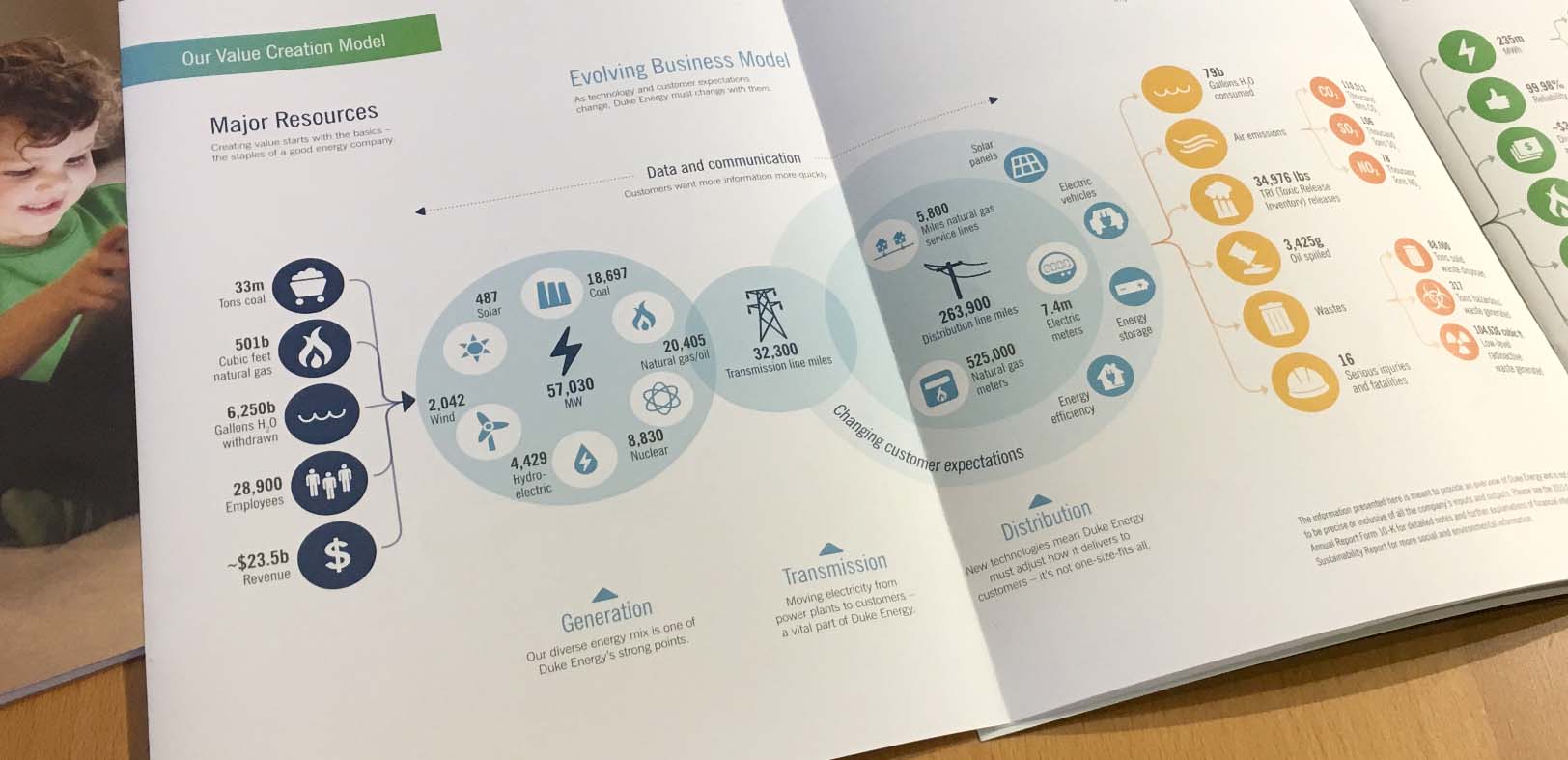
The Downloadable Data Summary is designed for institutional investors and ESG ratings agencies. It presents quantitative performance data across a one-, three-, or five-year horizon, stripped of narrative content.
Downloadable Highlights Document
The Downloadable Highlights Document is similar to an executive summary. It delivers the most significant developments of the year in a visually clear, concise format. Combined with strong data visualization and supporting graphics, it is the most accessible version of your sustainability story for audiences including employees, customers, suppliers, and community stakeholders.
Benefits:
- Provides accessible snapshots for time-constrained readers across all stakeholder groups
- Supports institutional investors and financial services audiences who need rapid data evaluation
- Can be tailored by audience — investors, employees, customers, or suppliers
- Extends the reach of the full report to audiences unlikely to read it in full
Touchpoint #4:
Stakeholder Amplification
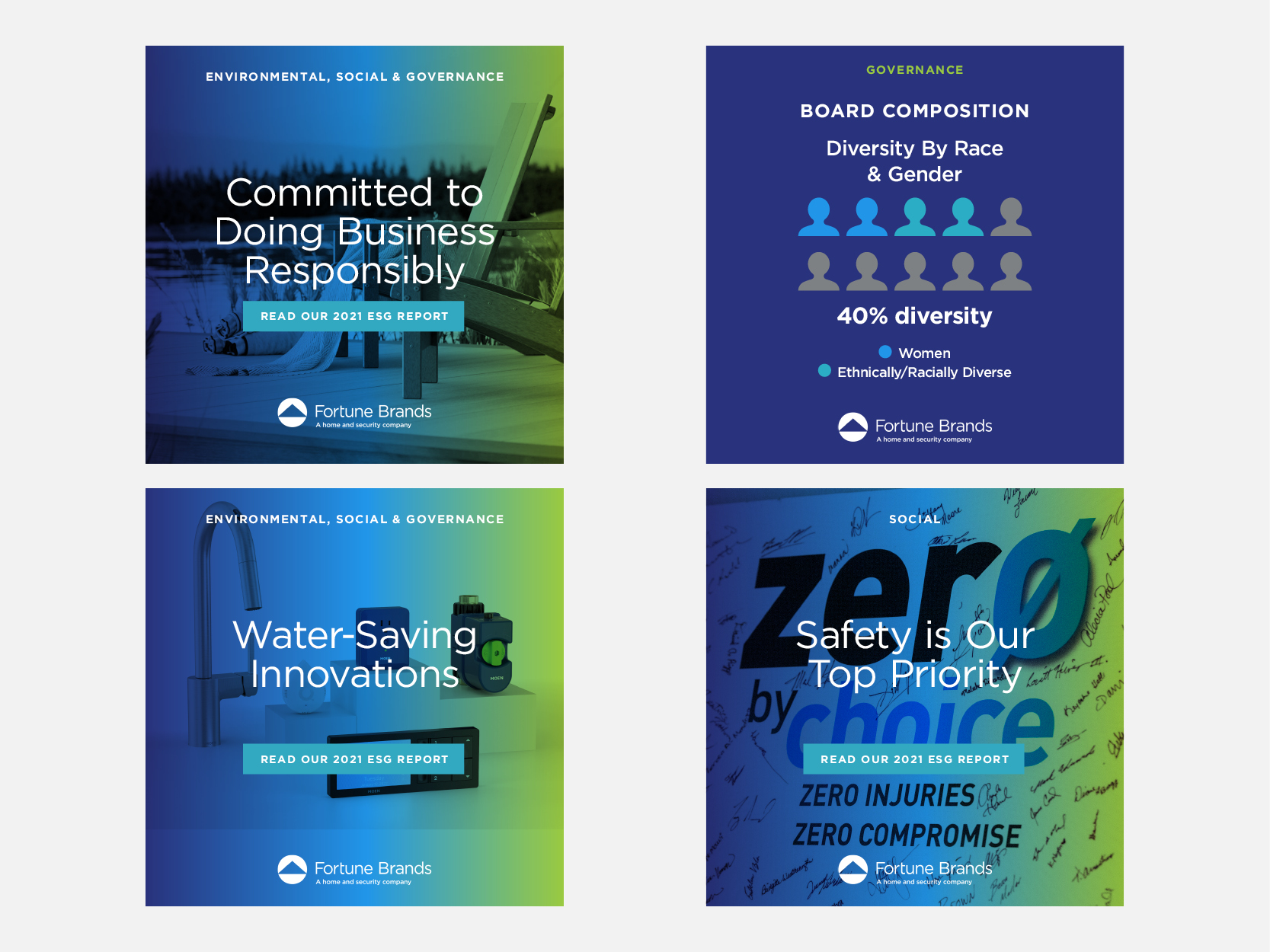
Stakeholder amplification is how companies extend the reach of their sustainability report, reinforce key messages, and demonstrate ongoing progress throughout the year. It is the most practical and widely used path to more frequent, transparent sustainability communication. The report is the disclosure. Amplification is how you bring it to each audience in the format most likely to create genuine engagement.
Content may include data-driven infographics, employee and community stories, progress updates on specific initiatives, third-party recognition announcements, or informed perspectives on regulatory developments. Done consistently, it builds a continuous narrative that makes the annual report a milestone in an ongoing conversation.
When OBATA helped Renesas Electronics develop its inaugural sustainability report, amplification was built into the engagement from the start. The strategy included a dedicated landing page, a highlights video, and bilingual social media assets in both English and Japanese — ensuring the report reached Renesas stakeholders across geographies, in the formats they would actually use. That kind of coordinated approach is what separates a report that is read from one that is filed.
Social media platforms
Social media platforms, particularly LinkedIn, are well suited for sharing data milestones, report launches, employee perspectives, and progress updates on specific initiatives. Content should be informational rather than promotional. A consistent visual template for sustainability content reinforces that this is a sustained commitment. More personal social platforms, such as Instagram or Facebook, can also be leveraged to build the company’s brand and help recruit talent.
Investor relations and stakeholder communications
Investor relations and stakeholder communications are increasingly used to weave sustainability progress into ongoing financial communications including earnings calls, investor day presentations, and IR website updates. Treating sustainability data with the same cadence as financial reporting is among the clearest signals a company can send to the investment community.
Website homepage promotion
Website homepage promotion at the time of report release increases awareness and signals that sustainability is a priority at the highest level of the organization.
For a detailed look at how to build the full strategy behind these formats — including audience mapping, framework alignment, and the connection between disclosure and amplification — see ESG Marketing Strategy: Communicating Sustainability With Credibility.
Benefits:
- Supports a continuous communication cadence between annual report releases
- Extends the audience for sustainability data beyond those who download the full report
- Reinforces ongoing commitment rather than seasonal announcement
- Builds trust through consistent, factual, year-round communication
OBATA is a strategic and creative partner helping companies develop and distribute sustainability and ESG reports that are as rigorous as they are clear. From annual reports and interactive PDFs to microsites, evergreen hubs, and stakeholder activation, we bring integrated expertise across every touchpoint.
Learn about our Sustainability Reporting services →
Related Resources
- The 7-Step ESG Reporting Process: Where Science Meets Art
- ESG Marketing Strategy: Communicating Sustainability With Credibility
- From Reporting to Action: Turning ESG Disclosures Into Real Impact
- The Future of ESG Ratings: Can We Trust Sustainability Scores?
- Integrated Reporting: Bridging Finance and ESG for Corporate Value