

How to Market Your Sustainability Strategy: Communicating Sustainability With Credibility
Sustainability & ESG, Guides / June 9, 2026
By Paul Gassett, Chief Executive Officer

Sharing your ESG marketing strategy with stakeholders has always been important. The rules, however, have changed. Expectations are higher, scrutiny is sharper, and the consequences of getting the communications wrong are real.
ESG marketing today is not simply about telling people what your company is doing for the environment or society. It is about demonstrating credible progress in a way that holds up to investor scrutiny, regulatory review, and public examination. That requires a different kind of strategy — one that starts with substance and works outward to communications, not the other way around.
This article explains how companies can build an ESG marketing strategy that is effective, defensible, and genuinely useful to the stakeholders who matter most.
What ESG Marketing Is Today
ESG marketing is the strategic practice of communicating a company’s environmental, social, and governance commitments, progress, and performance to its key audiences. It includes everything from the annual ESG or sustainability report to investor presentations, digital content, employee communications, and social media posts.
The role of ESG marketing has expanded significantly in recent years. Investors now evaluate ESG performance as part of financial risk analysis. Regulators in the European Union, the United Kingdom, and California have introduced mandatory disclosure requirements. New York, New Jersey, and Illinois have introduced similar legislation that remains pending. Supply chain partners are requesting sustainability data as a condition of doing business.
ESG marketing is no longer primarily a brand exercise. It is a communications function with direct business implications — for capital access, regulatory compliance, and long-term reputation.
Build Your ESG Marketing Plan Around Audiences, Not the Report
The most common mistake in ESG marketing is treating the annual report as the strategy. The report is a disclosure document. The strategy is how you use it.
Different stakeholders need different things from your ESG communications. Investors and ratings agencies — including CDP, MSCI, S&P Global, and Sustainalytics — want consistent, comparable, audit-ready data focused on material risks and opportunities. Customers want tangible proof that sustainability commitments are real, not aspirational. Employees want to see sustainability embedded in how the company actually operates. Regulators want framework-aligned disclosures that meet defined standards.
This means ESG marketing is a cross-functional responsibility. The sustainability team provides data and framework alignment. Legal and compliance ensure claims are accurate and defensible. Marketing and communications shape the narrative and format for each audience. Investor relations manages disclosures to the financial community. Senior leadership sets the tone.
Start by mapping your key audiences and identifying what each one needs from your ESG communications. Then build your content strategy around those needs.
For most organizations, a practical ESG marketing plan includes several content types: a well-designed, framework-aligned report as the anchor; an interactive digital version or microsite for broader accessibility; audience-specific summaries for investors, employees, and customers; executive-authored content that speaks to leadership commitment; and social media assets that make key data points accessible without oversimplifying.
When OBATA helped global semiconductor company Renesas Electronics develop its inaugural sustainability report, the activation strategy included a dedicated landing page, a highlights video, and bilingual social media assets in both English and Japanese. That kind of coordinated approach ensures the report reaches the audiences who need it, in the formats they will actually use.A practical framework for structuring this work runs from foundation through disclosure to stakeholder activation. OBATA’s 7-Step ESG Reporting Process outlines this approach in detail.
See how OBATA helped Renesas Electronics market their inaugural Sustainability Report
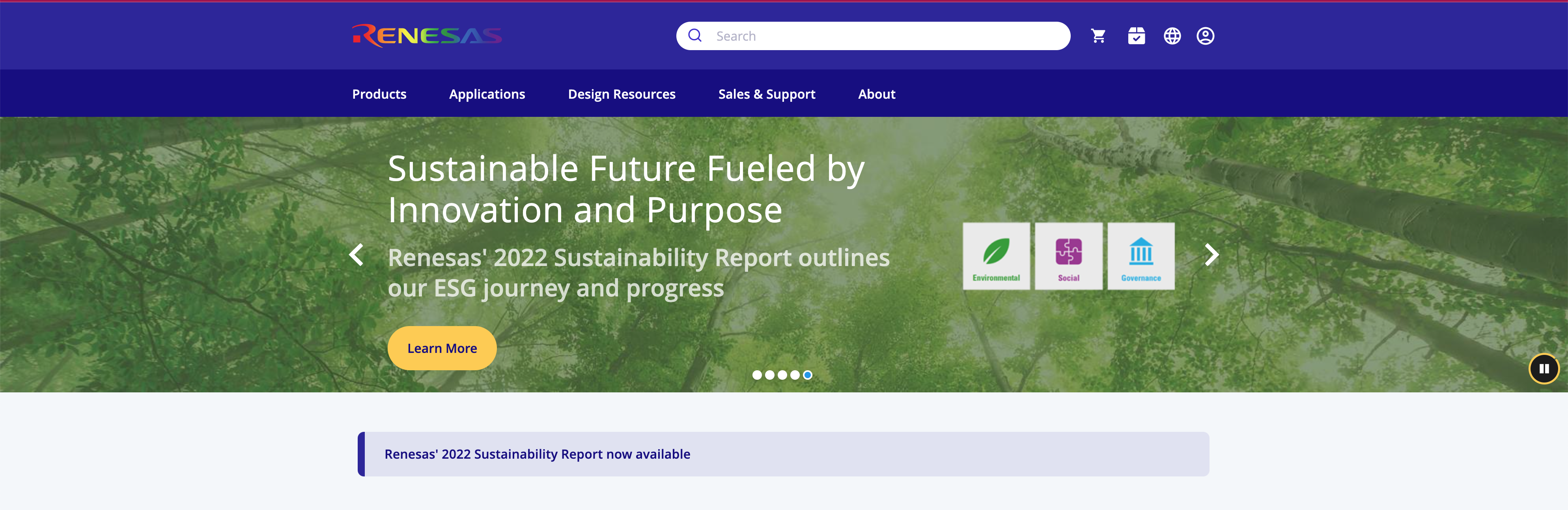
Renesas, a premier supplier of advanced semiconductor solutions, is headquartered in Tokyo, Japan. After OBATA designed their inaugural report, we were asked to help Renesas share the report by designing marketing tools that included a video, web page banner and images for social media posts.
Renesas highlights the report with a banner image and message and link on its homepage.
On the Renesas Sustainability landing page, we created a short video featuring a few highlights from the report.
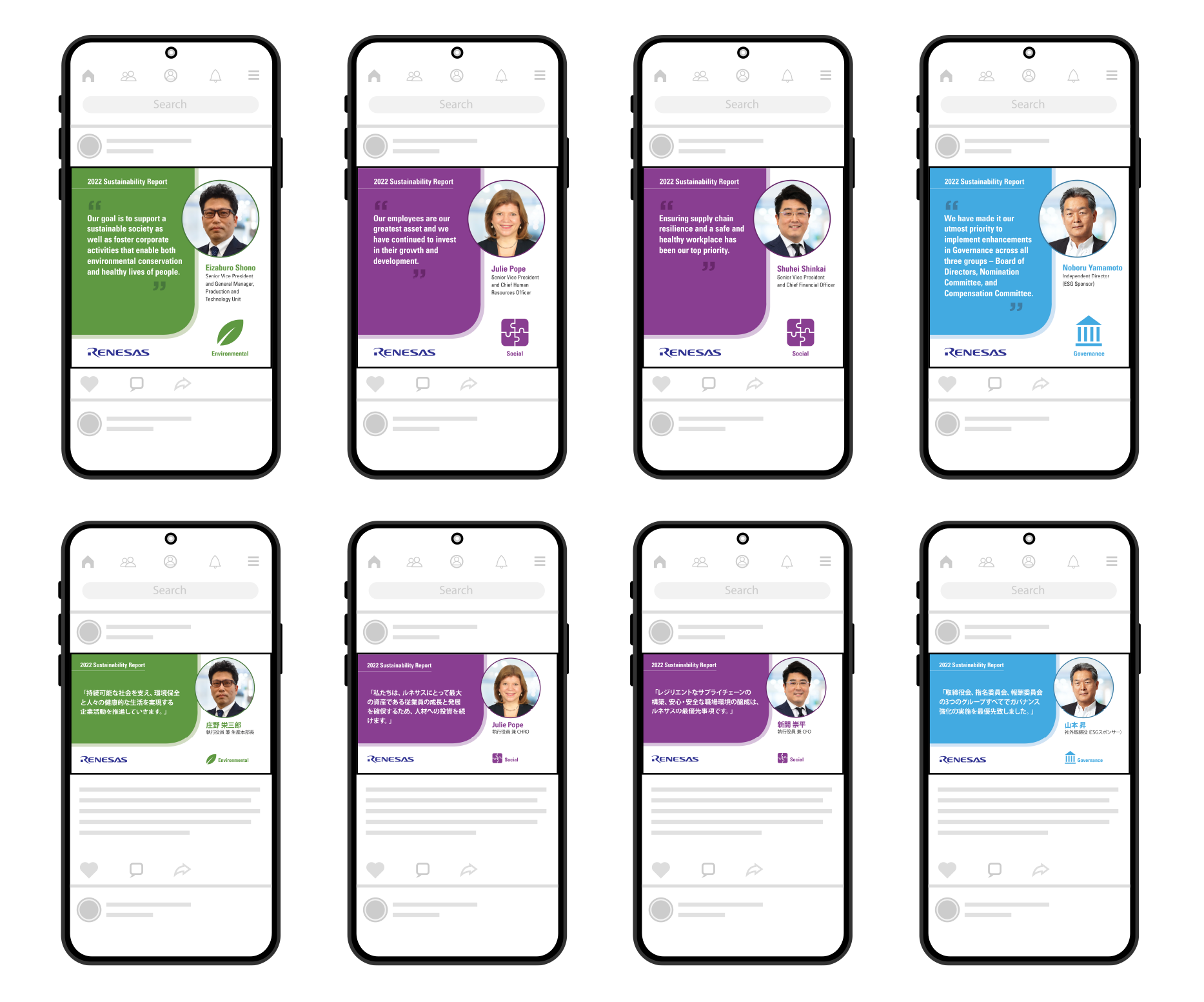
To increase awareness and viewership of the published report, we created several social posts using quotes from executives to introduce the report to stakeholders – created in both English and Japanese.
Credibility Is the Foundation of ESG Marketing
One of the most significant changes in ESG communications since 2023 is the intensification of scrutiny around sustainability claims. Greenwashing — whether intentional or not — has become one of the most serious reputational and legal risks companies face.
Regulators are moving to require verified, substantiated claims. The United Kingdom’s Financial Conduct Authority requires that FCA-authorized firms making sustainability-related claims about financial products and services ensure those claims are clear, fair, and not misleading. In Europe, the Corporate Sustainability Reporting Directive is producing the first wave of mandatory public disclosures from large companies. In the United States, California’s SB 253 and SB 261 mandate scope emissions reporting and climate risk disclosure for large companies doing business in the state.
For ESG marketing specifically, the implications are direct. Vague terms like “eco-friendly,” “carbon-neutral,” or “planet-positive” invite scrutiny when they are not backed by methodology, data, or third-party verification. Marketing language must be consistent with what the company actually discloses in formal reports. A gap between how a company markets its sustainability program and what it discloses in investor-grade documents creates legal and reputational exposure.
This is not a reason to say less. It is a reason to be more precise. Evidence-based communications, built on verified data and aligned to recognized frameworks, protect companies from accusations of greenwashing while building the kind of long-term stakeholder trust that broad claims cannot. For a detailed look at what greenwashing looks like in practice, how regulators are responding, and how to ensure your claims are defensible, see Greenwashing: What It Is and How to Avoid It.
Frameworks and Mandatory Disclosure Are Shaping What You Communicate
In 2023, companies chose from a set of voluntary frameworks and reported on what they determined to be material. That environment is shifting.
The International Sustainability Standards Board, commonly known as the ISSB, is emerging as the global anchor for sustainability disclosure, with 37 jurisdictions adopting or taking steps toward implementation as of late 2025, representing more than half of global GDP. The ISSB has effectively absorbed the Task Force on Climate-Related Financial Disclosures, known as TCFD, which disbanded in October 2023 after fulfilling its mandate — with its recommendations now fully incorporated into ISSB’s IFRS S2. The Global Reporting Initiative remains relevant, particularly for stakeholder-oriented reporting, while SASB standards, now part of the IFRS Foundation, inform sector-specific metrics within the ISSB framework.
For U.S. companies doing business in California, mandatory disclosure under SB 253 and SB 261 is a near-term operational reality, with the first SB 253 Scope 1 and 2 emissions reports due in 2026. OBATA has published a detailed compliance guide on what these laws require, key deadlines, and how to prepare.
Understanding which frameworks apply to your organization is not just a compliance question. It shapes what you communicate, to whom, and in what format. An ESG marketing strategy that is not anchored to the right frameworks will create inconsistencies between your public narrative and your formal disclosures. That inconsistency is itself a risk.
Distribute and Activate Your ESG Report
A report that is not read has no impact. Distribution and activation extend the life of the report and expand its reach.
The downloadable PDF remains the standard delivery format. Companies that rely on it alone, however, miss much of their potential audience. Interactive digital reports and microsites make data more accessible and searchable. Executive highlight summaries serve investors and board members who need the essential points quickly. Short videos featuring CEO or chief sustainability officer commentary add a human dimension that data alone cannot provide. Infographics and social media assets allow key performance figures to reach audiences who will never open a PDF.
Each of these formats serves a purpose. The goal is to take one body of verified, framework-aligned work and bring it to each audience in the format most likely to create genuine engagement.
Consistency is the discipline that makes this work. Every activation asset should reflect the same data, the same claims, and the same narrative as the formal report. When marketing and disclosure speak from the same foundation, the result is credibility.
For practical guidance on the formats available for sharing your report, see Four Smart Ways to Share Your ESG Report.
Choosing an ESG Communications Partner
Strong ESG marketing requires both analytical rigor and communications expertise. The data must be accurate, framework-aligned, and defensible. The narrative must be clear, audience-appropriate, and consistent across every channel.
Few organizations have all of this capability in-house. Working with a partner who understands sustainability frameworks, investor expectations, regulatory requirements, and design is one of the most effective ways to close that gap.
The right partner does more than produce a report. They help you identify material topics, align to the right frameworks, build a narrative that reflects genuine progress, and develop the activation strategy to bring that narrative to each of your key audiences. That kind of integrated approach reduces internal burden, improves report quality, and ensures the final work holds up under scrutiny.
OBATA has helped companies communicate their sustainability and ESG programs for more than 25 years, across 15 industries and more than 100 reports. Our work spans the full reporting cycle: strategy, disclosure, design, and stakeholder activation. Explore OBATA’s ESG and Sustainability Reporting Services to learn how we approach this work.
Frequently Asked Questions About ESG Marketing
What is the difference between ESG marketing and sustainability marketing?
The two terms are often used interchangeably. ESG marketing typically refers to communicating performance across the three specific pillars of environmental, social, and governance factors, often in the context of investor-grade disclosure. Sustainability marketing is broader and may include community impact, brand purpose, and long-term value creation for all stakeholders. For most companies, the same communications strategy serves both.
Which stakeholders should ESG marketing prioritize?
Investors and ratings agencies require consistent, audit-ready data. Customers and the public need tangible proof of progress. Employees need to see ESG embedded in operations, not just reported annually. Regulators require framework-aligned disclosure. An effective ESG marketing plan addresses all four audiences with content tailored to each.
What is greenwashing and how does ESG marketing avoid it?
Greenwashing occurs when a company’s sustainability claims are vague, unverified, or inconsistent with its actual performance. ESG marketing avoids it by grounding all claims in verified data, aligning language with formal disclosures, and using recognized frameworks such as GRI, ISSB, or SASB to substantiate performance statements.
Do U.S. companies need to follow ESG disclosure requirements?
Yes, depending on size and location. California’s SB 253 and SB 261 require large companies doing business in the state to disclose GHG emissions and climate-related financial risks. New York, New Jersey, and Illinois have introduced similar legislation. Internationally, the EU’s Corporate Sustainability Reporting Directive applies to companies with significant European operations. Federal SEC requirements remain uncertain as of early 2026.
How long does it take to develop an ESG report and marketing strategy?
Most comprehensive ESG or sustainability reports take four to six months from kickoff to publication. The activation and marketing strategy runs alongside and after that process. Organizations with existing data infrastructure, prior reports, and defined frameworks move faster than first-time reporters.
Ready to build an ESG marketing strategy that holds up under scrutiny?
Book a complimentary consultation with one of our sustainability reporting experts.
About the Author
Paul Gassett is the Chief Executive Officer of OBATA, a strategic communications partner specializing in sustainability reporting, ESG disclosure, and brand communications. Paul brings more than 25 years of experience in marketing and brand communications, including more than 15 years in corporate reporting and a focused practice in ESG and sustainability communications. He leads a team of GRI-certified sustainability professionals and corporate communications specialists who have delivered more than 110 sustainability, ESG, CSR, and impact reports across 15 industries. OBATA’s work has been recognized by GDUSA, LACP, Hermes Creative Awards, APEX, and MarCom Awards for excellence in corporate reporting design.